

I was having lunch with someone and got into an argument about the reason for putting up solar panels. It was weird to be faced with a different worldview when I felt my view was the obvious answer. It was even weirder to acknowledge that their reason was also perfectly valid, but I still felt triggered. So this got me thinking. This person is not a bad person, I just don’t think he ever even saw the need for care, giving it or receiving it. So what is that worldview, and why is it so different to mine? I wanted to call him selfish, but that wasn’t it. It was more … individualist.
I got thinking about how to figure this out. Chatting with Claude, inspired by Carol Gilligan’s views, a quadrant shook out (I do love my quadrants): individualist – relational on one axis, and selfish – generous on the other. I’m not completely convinced about it all, but it’s helping me think through how to define a “feminist ethic of care” in real, measurable terms (which I need for the AquaCurious methodology).
OK, this is still a work in progress but I’m tired. Shelfing it for now.
Individualist vs. relational is about locus: where do you place the unit of analysis — the isolated self, or the self as a node in a web of others? It’s a question about what you take as the core important thing (an agent, or a set of relations).
Selfish vs. generous is about orientation: whose interests are you serving when you act? Who benefits?
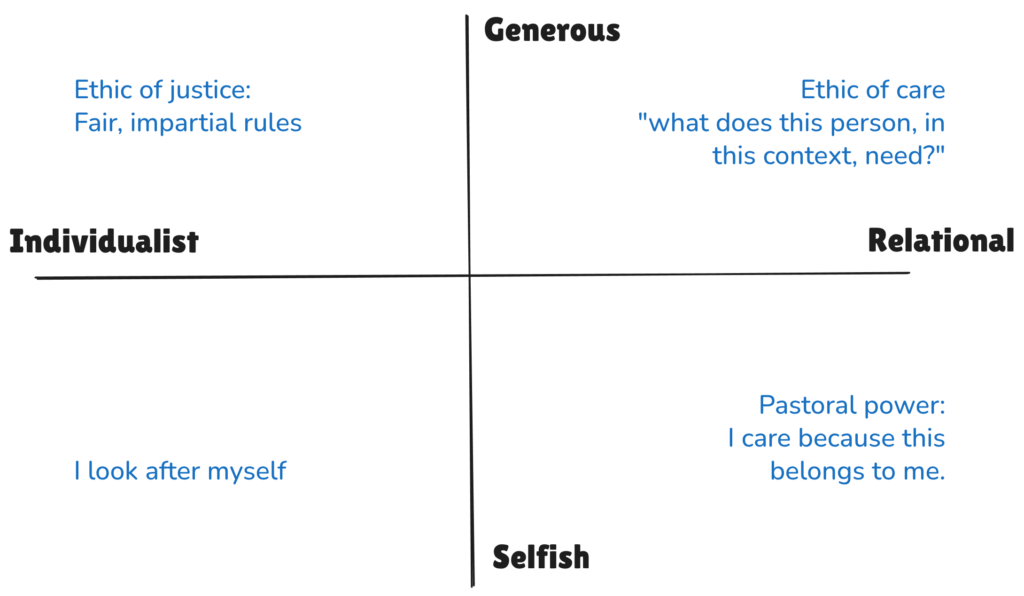
Important to note: Being individualist, or being relational, being selfish or generous are all coherent, legitimate ethical orientations. They’re not good, or bad, they just are. They could go either way. (TODO: pastoral has baggage, probably not the best word for this image? Individual-selfish needs a name)
I liked how both ethic of justice and ethic of care converged to generosity, but through different routes. One through impartial rule, abstracting justice into a set of rules, and the other through relational attunement. It shows they both have their place and should complement each other. I like how this situates us having to deal with our complex environmental challenges – the need for polycentric government. I like how this provides a stage for how different actors with different ” coherent, legitimate ethical orientations” have to start working together out of necessity, and all the potential for hurt that can cause.
As Claude put it: you get a utility engineer running individualist-justice (rules, standards, fairness applied uniformly), a community organizer running relational-care (attentive to this specific neighbourhood’s needs), a municipal official running individualist-generous (does their job competently, doesn’t ask for help, doesn’t offer it unprompted either), and maybe a civic volunteer quietly running relational-generous — anticipating, monitoring, absorbing the coordination labour that keeps the coalition from falling apart. I guess I’d add corporate actors who have to be individualist-selfish to make sure their company stays afloat.
As I started to unpack this though, I had trouble staying “neutral” – I wanted to call some of these categories bad. And then I thought, but where am I in this? I’m really struggling at the moment because I feel invisible, carrying too much and burnt out. I mean, I want to think I am relational – generous, but clearly I am not looking at myself as also one of these people who need care.
Sparring with Claude on this, we eventually ended up on a third axis, that of the effect of patriarchy poisoning these quadrants. Patriarchy as a defence mechanism. Remember, Carol had her three discoveries about why patriarchy persists:
- It is trauma, not development, that separates reason from emotion
- Pathological defences against loss is the patriarchal ideal (basically being a psycho)
- Patriarchy subverts the capacity to repair relationship, by shaming the human capabilities that are vital to reach across the boundaries of conflict and difference.
So you can imagine why someone would want to be selfish, only look out for themselves. Anything else hurts too much. You can imagine why care gets corrupted into manipulation and control.
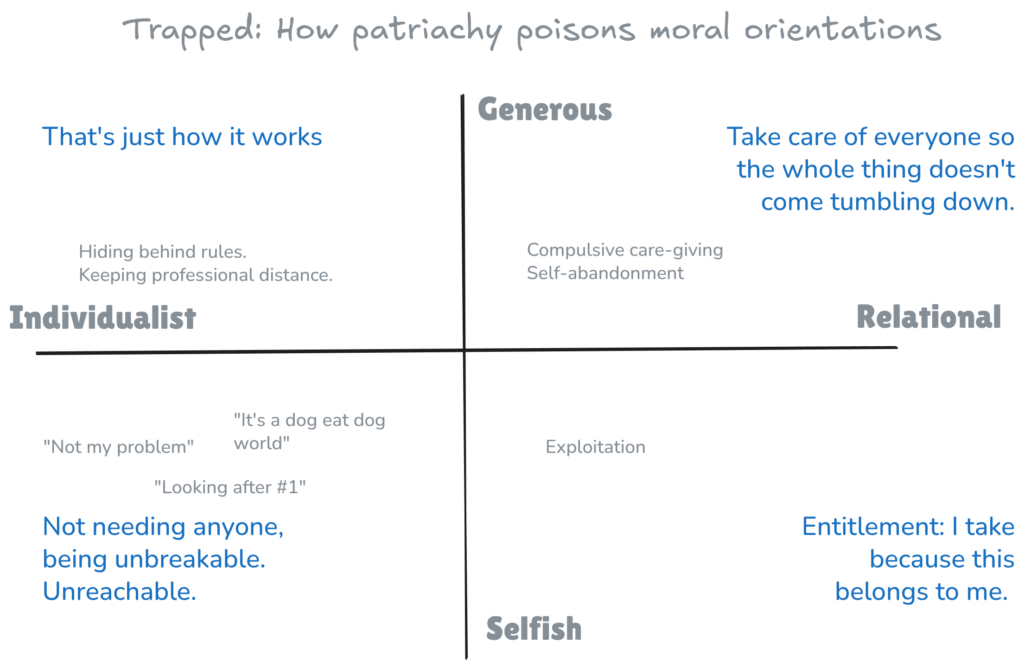
My original tendency to consider some of these orientations bad, were really just where the effects of patriarchy is easiest to see. Justice and care, the generous aspects, are affected as much, they’re only harder to catch because they look virtuous while doing it. Ouch.
What does this look like in a better world?
I’m calling the two versions of these orientations “held” (not having patriarchy) and “trapped” (by patriarchy). Both words describe something done to you by your surroundings. “Held” = the environment supports you without you fighting for it. “Trapped” = the environment closes in regardless of what you do. I see the “held”, less than “someone hugs you”, and more as “the ground holds you up”. And when you are trapped, you can acknowledge that “you’re not an asshole, you’re trapped”. Not a great situation, not really an excuse, still your responsibility to navigate out of, but you’re not a terrible person. We can work with that.
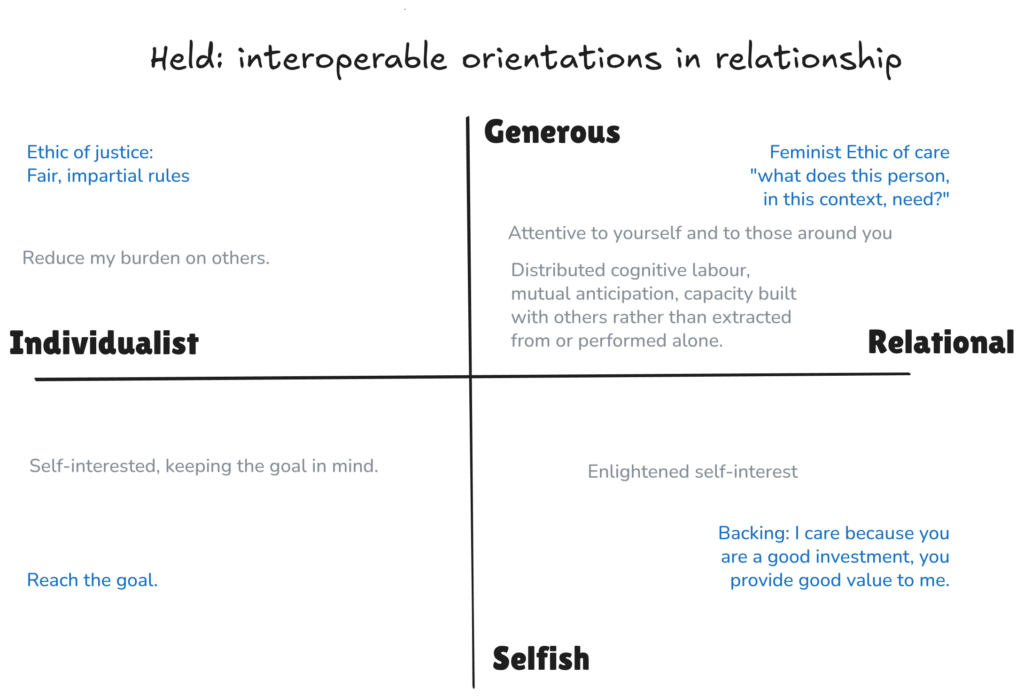
TODO: I’m not sure about these words and categories. “Selfish” carries a lot of baggage so it’s hard to see it in positive terms.
The point to remember is that, tempting as it is to “make everyone care more”, and yes, we do need more people moving into the relation-generous quadrant, it is really about the current situation being mismatched-but-legitimate orientations meeting without shared circuitry. A feminist ethic of care is, more than any individual disposition or skillset, an infrastructure question about building the interoperable circuitry. “Circuitry” here meaning, not, everyone magically gets (or gives) care, but, that care can circulate and come back – relationship. And so, that is what I’m trying to develop in AquaCurious, the holding structure of this … infrastructure.
Other stuff: (I’ll probably cut this into a new post?)
Why “feminist” ethic of care? Why not just, ethic of care?
When I asked Claude how we can apply this to AquaCurious (I was expecting a theoretical framework but it gave me the self-help manual, useful but not relevant for here), one of the things it said was it is tempting to try to get everyone into relational-generous (guilty). But an engineer running individualist-justice isn’t broken; they’re coherent. Trying to make them “more relational” is its own kind of soft paternalism. This hit a gut-punch and is why I was so reluctant to head into the humanities field for so long. I didn’t want the touchy-feely stuff: shit needed to get done, and I don’t want to get shamed for biting the bullet. It said that Elinor Ostrom recommended interoperability between orientations. Where this polycentric angle meets Carol is that we have to address the patriarchal wounds to get these orientations to gel properly. In my opinion.
Literature on relational autonomy tends to be more a ‘reaction against’ an individualistic interpretation of autonomy rather than be a positive concept itself (Gómez-Vírseda et al 2019). I feel that this happens a lot, and I feel the punk movement is also a response against something rather than moving towards something better.
In a previous conversation I need to go dig up (TODO), I ended up distinguishing between two types of punk:
Pop-punk sits in individualist territory, but importantly, more individualist-generous than individualist-selfish, at least in its own self-image. “Stick it to the man,” DIY, self-reliance, not needing permission from experts or institutions. Not selfish exactly, just self-sufficient, resistant to dependency. Individualism dressed as defiance rather than as greed. I call this pop-punk, the modern punk, because I don’t like the “Stick it to the man” vibes, the fighting against something, not for something.
The conversation I need to dig up relates to my irritation with punk, as with my arguments with Jonas. (Note to self to go find this) When I mentioned this to Claude, Claude pushed back that punk is how I describe feminist ethic of care, and then I fought back with my reasons why it isn’t, and we got to some sort of an agreement, that punk has changed and isn’t without issues, obviously (and some academic articles unpacking that).
So then I named the original punk that was more similar to a ethic of care, or relational-generous, as OG-punk:
OG-punk: bottom-up, DIY-as-collective, mutual aid, “designed by or with users”. OG-punk is about distributed capacity rather than a lone rebel, lone hero or a lone rule-follower.
The thing is, that OG-punk gets to a relational generosity via rejection. It starts from resistance to imposed authority, “no gods, no masters,” rejecting the pastoral power (Foucault) of experts and the relational, mutual-aid structure is what’s left standing once you’ve torn down the hierarchy. The relational stance is a byproduct of refusing top-down control. A feminist ethic of care gets there by attunement. I feel like it starts from looking at who we are, who we are meant to be, before patriarchy ruined it, and then builds that up again. It doesn’t start from rejecting anything. It starts from noticing unmet needs, anticipating, monitoring – the relational stance is the point, not a side effect of tearing something else down. I feel like punk is a bunch of loveable boy-thieves. Their reason for being ruffians can’t really survive once you’ve destroyed all the pastors, what is there left to fight then? Whereas a feminist ethic of care just carries on with what needs to happen, like old witches in the forest. Once the pastors are gone, great, we can get on with things with less hassle.
Punk correctly diagnoses the problem (dependency-on-experts/authority is a real trap) but its answer, taken at face value, is individualist (“become your own expert”). So you need this extra effort to get to OG-punk’s collective wing. It’s a continual hassle to not punk-in-smuggle in the relational move without ever quite naming it as care. That’s not sustainable. My point of all this is that punk is a response to patriarchy, and it still suffers from the lack of capacity to repair relationship. I want something independent of patriarchy altogether.
Some academic sources
Apparently the “individualist-selfish” thing is framed as “relational autonomy”.
- Mackenzie, Catriona, and Natalie Stoljar (eds), Relational Autonomy: Feminist Perspectives on Autonomy, Agency, and the Social Self (New York, NY
, 2000; online edn, Oxford Academic, 31 Oct. 2023), https://doi.org/10.1093/oso/9780195123333.001.0001, accessed 11 Aug. 2026.
Feminist philosophers arguing that autonomy itself needs to be reconceived as socially embedded rather than abandoned as a value, because the traditional “autonomous self” model was already doing damage by treating independence as the ideal. Relational autonomy is said to promote decision-making guided by an ethic of care and moral responsibility, and another source frames it as: relationships, responsibility, care and interdependence are key attributes of relational autonomy, since people develop their sense of self and form capacities and life plans through the relationships they forge daily and over time. - Gómez-Vírseda, C., De Maeseneer, Y., & Gastmans, C. (2019). Relational autonomy: what does it mean and how is it used in end-of-life care? A systematic review of argument-based ethics literature. BMC medical ethics, 20(1), 76.
on pastoral power:
- Foucault Security, Territory, Population (1977–78 lectures) and the essay “The Subject and Power,”
- Eyal – Crisis of expertise.