A presentation to the WESSA Big Friends Group (BFG) Event held 4 August 2018 at Rondevlei Nature Reserve
Continue reading “Rethinking our relationships with ‘the wild’”


Interfaces, Spaces Between
A presentation to the WESSA Big Friends Group (BFG) Event held 4 August 2018 at Rondevlei Nature Reserve
Continue reading “Rethinking our relationships with ‘the wild’”
This is the presentation (pdf, 5MB) given at the Collaborative African Budget Reform Initiative (CABRI) workshop on policy and funding strategies to improve WASH service delivery, held 6 to 8 June 2018.
It was also the first time I formally co-presented with Joshua Palfreman. Continue reading “Give dry toilets a fighting chance – Masterclass at CABRI”
Please note: I’m busy moving blogs, and copied this content over. The image links are going to break, if they haven’t already. It is what it is.
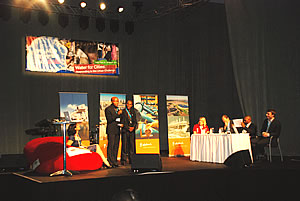
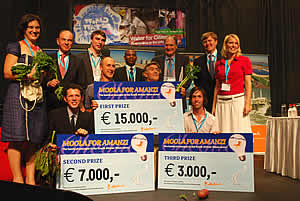
The report below is adapted from the WaterNetwork website. Merah Mas founder, Bernelle Verster was the main organiser of this initiative. The competition, which was part of a bigger initiative – the Dutch-SA water partnership – aimed to generate high quality investment proposals addressing water and sanitation issues and build awareness in the public eye, the water sector and sectors outside conventional water-related industries, so that business can go hand in hand with access to clean and affordable water.
World Water Week 20-23 March 2011 in Cape Town, South Africa
Please note: I’m busy moving blogs, and copied this content over. The image links are going to break, if they haven’t already. It is what it is.
WaterBus = Schools Water Awareness and Education Project. Continue reading “Waterbus”
Please note: I’m busy moving blogs, and copied this content over. The image links are going to break, if they haven’t already. It is what it is.
Forbes! Continue reading “Forbes!”
A talk I gave at Green Drinks: Bernelle Verster, 18 September 2011. It’s still a favourite.
Please note: I’m busy moving blogs, and copied this content over. The image links are going to break, if they haven’t already. It is what it is.
The transcript of the talk I gave at the SA Geography teachers conference, on 24 September 2014.
The title, roughly, is Permaculture, water and the landscape: the connectedness of things
The attendees made for a lovely audience, so much laughing in all the right places that I got totally overexcited. 🙂 I’m not quite happy with the structure and content of this talk yet, but I think it’s starting to get there. (As a point aside, I think I should make a talk that gets into the nitty gritty of Permaculture, water and the landscape, but first, I need to write 3x 4000-6000 word essays on the PhD… sigh) Also, this was the first talk where my special person was in the audience. That was … different.
This post was developed as a submission for The Conversation. I have to rework it because “the article covers a huge amount of ground, and that there isn’t immediately a ‘golden thread’ that can be easily identified.” I like it, so it’s going to live here in its current form 🙂
When the probability of Day Zero was first announced in January 2018, the realisation that the extreme drought in Cape Town may affect the functioning of the sewer systems became apparent to everyday people. Through my work in [resource recovery from wastewaters](http://www.futurewater.uct.ac.za/FW-WWBR) and particularly how [sanitation can contribute to the circular economy](http://www.toiletboard.org/media/17-Sanitation_in_the_Circular_Economy.pdf) I have been thinking about the benefits of dry sanitation. I am intrigued by the potential of biological means to recover value from diffuse pollution. But could they ever be introduced at large scale?
This piece brings together concerns that I have from observing responses to the Cape Town water crisis. It was developed as a talk (slides here) which I never got to give, so I would appreciate input to guide me to develop this further.
This talk is in 5 parts:
Continue reading “Experting in times of crisis: Ethics of care.”
Why? We’re in drought, so we don’t have water to flush toilets. The nutrients in shit should be re-used, and that is difficult when we dilute it with loads of water and mix it with god knows what else to be shipped off somewhere to be so-called ‘treated’. Also, flushing toilets mean we are flushing nutrients into receiving water bodies (even with excellent wastewater treatment, we’re still not doing well enough). So flushing is just a stupid idea. More about this in a presentation (pdf, 5MB) I recently gave. Continue reading “Jouissance toilet 2.0 – the foam flush”