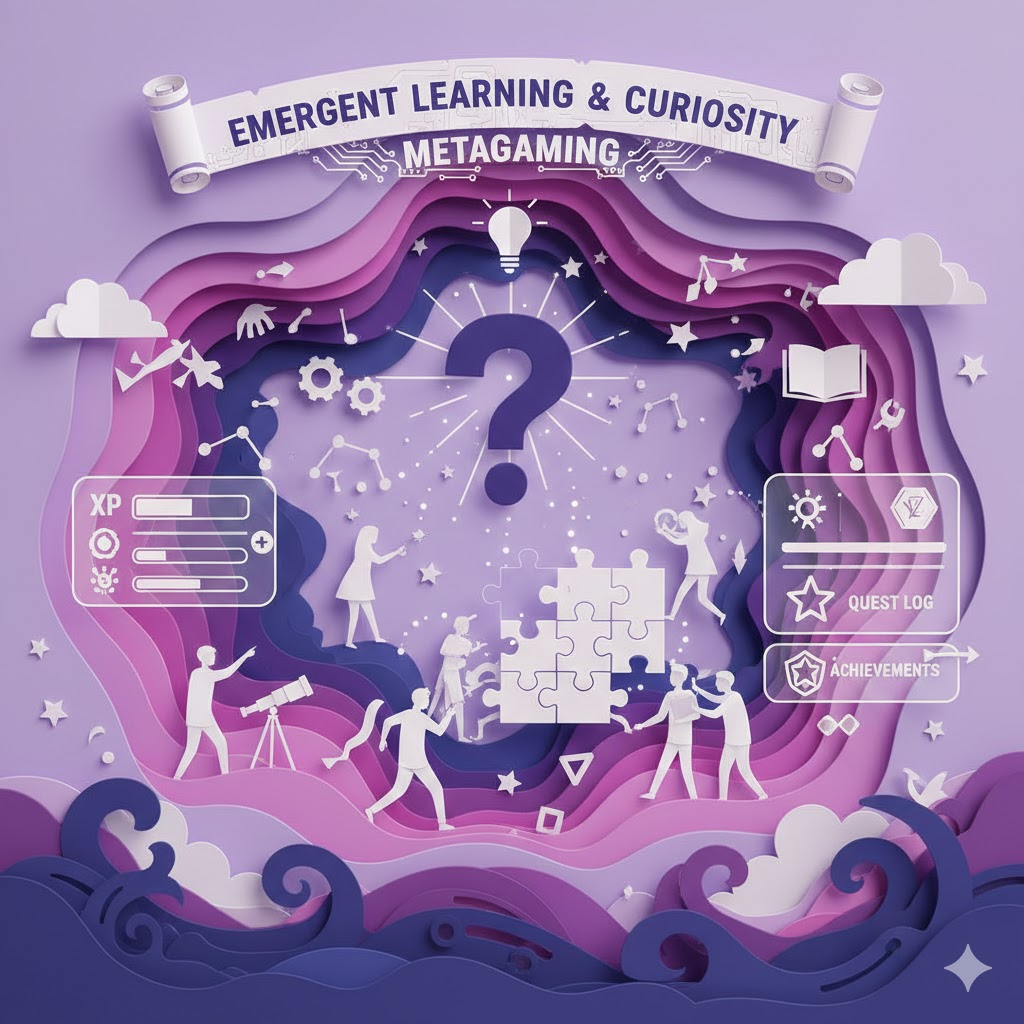
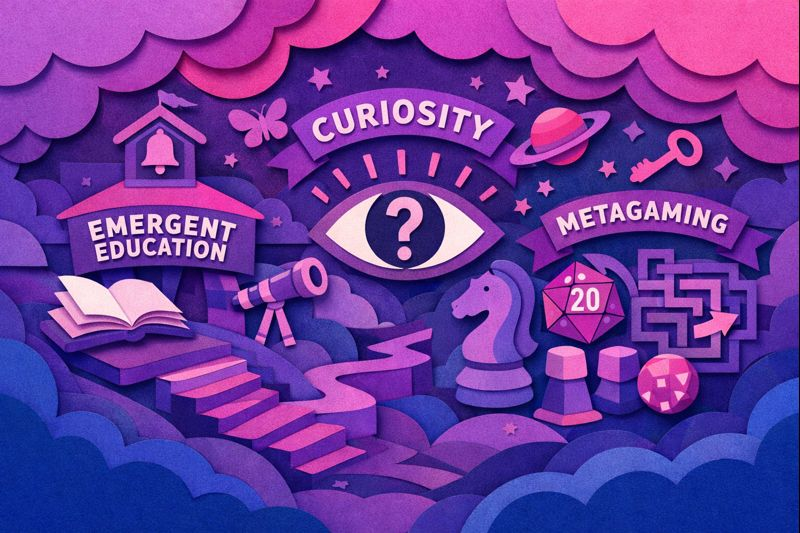
Or, Education as an emergent game, where metagaming is core to play. I’m presenting this at the Virtual Worlds Best Practices in Education: Insights conference, happening online in SecondLife March 19-21, 2026. This is adapted from a piece submitted to the Virtual Education Journal which in turn led from a presentation at the Open Simulator Community Conference.
Exploring playing with the physical world – morphing and changing it – through games can allow us to learn about the world not through a top-down education, but through a curiosity that does not even have to involve the truth. Through these games we can build a new sense of community and belonging, that builds a common language across polarised opinions, because it’s just for fun, after all.
“Exploring the world is great and all that, but poking fun at exploring the world? Oh hell yes.”– Mike Sowden
Part A: Some core concepts first, what do I mean with Emergent, Education, and Metaplay?
1. Emergence
Emergent games refer to a type of gameplay that arises from the interactions and behaviors of players within a game system, rather than being predetermined by the game designers. This type of gameplay is often characterized by complex, dynamic systems and open-ended rulesets that allow players to create their own experiences and stories within the game world. The sandbox concept is one application of this, and of course Second Life as a platform is probably the most famous example of encouraging this form of play. So you know all about this.
2. Education
Disclaimer, I am not an educator, and I know there is a lot more innovation out there than what I am aware of. It is amazing and humbling to be invited to speak here, at the Virtual Worlds Best Practices in Education, which is a community event focusing on education in immersive virtual environments. So I am at the right place to … get educated!
My personal frustration with education is the type that delivers content at learners, that you are supposed to absorb passively, without questioning. It links with how our relationship with absorbing media and news has changed; that we participate in its creation as much as we consume it – convergence culture as per Henry Jenkins. On the other hand, as a scientist, how does this approach tally with … so-called truth? Like, climate change or the covid pandemic, or, “politically charged scientific questions”, as Gil Eyal puts it? Are they compatible? When is something a sacred cow, not to be touched?
Just asking my AI how education is defined, it said “Education is generally understood as the process of facilitating learning, or the acquisition of knowledge, skills, values, and habits.” That sounds great, so far so good. But I then asked, is there a definition that distinguishes between delivering content for absorption, and allowing learning through discovery, or curiosity? The AI says: There’s a distinction between education that focuses on transmission of knowledge, where students absorb pre-defined content, versus a more constructivist approach, where learners are encouraged to discover and construct their own understanding through curiosity-driven inquiry.
So I think I am here talking about the constructivist approach. As hinted by my earlier question, my focus is more on people who are challenging “the system”, who are vulnerable to misinformation, populism, and radicalisation. So let’s call it continuing education rather than curriculum education, but of course the same tool can be used in formal curricula, why not.
Emergent Education
Applying the emergent game context to education can create an ecosystem where creativity can thrive, for the learners as well as the educators. This approach shifts the focus to the player, giving the learner agency to explore and question their world, by focusing on building a playground with relatively open goals, and the verbs and game mechanics to find their own fun and solutions to the problems presented. As the ample literature on using Minecraft and virtual worlds for education shows, – and the existence of this conference! – this is a very promising area for education, but it is still often a limiting and frustrating experience.
We can improve on this in one way by extending the ecosystem beyond a specific platform, making platforms and the data within them interoperable, which I will get into in a bit. If you choose to have your community, and your virtual education, for example in SecondLife, and you want to join up with another community in Open Simulator, or VRChat, or Minecraft, you should be able to do that. Or, if, you know, you want check out if you can see the Northern Lights tonight, and then pull in those rays of lights into SecondLife to have a watch party, you should be able to do that. That will probably mean integratingNOAA into your world, and then I guess do some coding or something to take the probabilities of the aurora happening and then maybe link that with some video stream and then convert that to a visualisation that is suitable to pull into SecondLife, I don’t know. But you should be able to do that.
Perhaps you have a unique platform developed that is specific to your needs, or someone made an industrial simulation available for education, those should seamlessly interoperate into your activities or curriculum.
And what if you want to touch those light streamers and have your hand change how they flow, let the ribbons weave through your hands like a soft silk fabric, and change the physical truth of how the auroras happen? Or use the same type of visualisations to show things you can’t really show in the physical world, like the flows of pollution in rivers, or … the flows of political funding. It’s your virtual world, you should be able to do that. And then, maybe, you think, but what makes this happen? And then you go off into a rabbithole about magnetic interference and industrial production upstream or rivers or whatever, I don’t know. But it’s playful and curious and maybe along this journey you realise the earth isn’t flat after all. And nobody judged you along the way, you were just playing.
That’s what I want. I don’t want a boring lecture, or have a fight with someone over if the world is flat or round, who cares. Come play in the aurora with me. Come change the value of gravity so we can float around together.
3. Metaplay
In traditional role-playing games, metagaming refers to the use of real-world information that the player character should not know about. A metagame can mean cheating, or refer to achievement systems and other official elements outside the actual core game. While the use of the term varies by context, some positive, some negative, the different meanings have in common a reference to something beyond the game itself.
I want to use the term metaplay to claim the positive reference around metagaming, and to consider the playing that extends play beyond the game boundaries. Metaplay can then refer to the creative and playful activities that can involve the manipulation of game mechanics, pushing boundaries, or experimenting with alternative ways of playing. Metaplay is then the emergent playfulness beyond what we would typically consider as available for playfulness. There are no sacred cows. Our NOAA database would be an example of metaplay. This conference is a metaplay with SecondLife.
Metagaming for education
I first came across the term metagaming through an article by Juho Kahila’s group, where they investigated how school learners engaged with games for educational purposes.
In their article “A Typology of Metagamers: Identifying Player Types Based on Beyond the Game Activities”, Kahila’s group looks at what happens beyond the game. They talk about three distinct profiles of players: versatile metagamers, strategizers, and casual metagamers. The authors mapped the students’ metagame activities into the main categories of game-enabling activities, strategizing activities, discussing activities, information-seeking activities, creating and sharing activities, and consuming activities. Important to note here is that it was not expected that all the players engage in gameplay, or metaplay in the same ways.
Part B: Are there sacred cows? Should truth be the ultimate thing we protect?
I asked earlier, as a scientist, should we preserve “the truth”? Or, in other words, how do we engage with politically charged scientific questions, that do not have straight-forward answers and have a lot of political trade-offs behind them?
In our modern world where Wikipedia was first scoffed at as a resource, then reluctantly embraced, in this convergence culture where content is created by everyone, where the idea of an “expert” is no longer clear-cut, how do we work with that? More topically, with the current challenges and opportunities with AI, education needs to move from ring-fencing the “game” of education, to teaching how to engage critically with the “metagaming” wealth of information (and misinformation) that exists beyond the education sandbox.
It’s not about the sacred cows. It’s not about the truth. It’s about how we relate to each other. That does not mean we discard so-called truths, but we need to change how we try to protect those cows. We gain nothing by hurting each other while we try to protect a sacred cow, aka, “the truth”.
Addressing the crisis of belonging
The rise of misinformation, and a world that has become more angry and divided, really bothers me, so I set off on this journey to learn how to make it better. What is fuelling the need for an alternate truth? Most of what I read seems to point to a crisis of belonging. Does this mean truth cannot co-exist with fun, with play, with belonging?
I am a scientist, and an engineer, and I work to improve our relationship with nature. To reverse climate change and regenerate our environment. But I have learnt that we can’t move the needle on that until we improve our relationship with ourselves and each other. If we do not have fun, and play, and belonging, truth will not survive.
This “crisis of belonging” links to a psychology of loss, according to Carol Gilligan. And this psychology of loss links to the politics of patriarchy – of otherness, of us versus them. The rise of populism, of post-truth can be seen as a fight to preserve this othering mentality, let’s call this “the system”. The politics of this “system” that tries to keep us afraid and pushes this us-and-them mentality we’re seeing everywhere, is a way to break relationship. Without relationship we are controllable. We can be manipulated. And so, democracy, equality, true belonging is a threat to patriarchy, to this current system.
So how do we break this manipulation of ourselves?
Carol Gilligan talks about resisting patriarchy through association, learning to listen in ways that generate trust. Naomi Klein wrote about how to constructively engage with misinformation, and Anand Giridharadas wrote on building connection across political divisions. The one thing that kept coming up was not educating people, or improving literacy, but reducing friction by cultivating curiosity.
So this talk about education, emergent education, metaplay, is, yes, about learning, but it’s about a specific approach to learning, an approach that builds relationship. I think digital approaches, and virtual worlds, have a unique ability to help with that. Maybe it’s about looking at the positive aspects of hyperreality?
Cultivating curiosity rather than literacy
I don’t think truth and belonging has to be mutually exclusive, but there is a certain suspension of conviction needed to allow curiosity. And through curiosity, we can recreate belonging. And then, together, we can rediscover truth, perhaps. I suppose it’s also worth mentioning that this is a feminist approach, but I hope it’s pretty clear that this has nothing to do with men, or women. “Patriarchy vs feminist” being interpreted to mean “men vs women” is just another us vs them manipulation tactic.
4. Emergent education + Metaplay = Curiosity
Tim Harford has the best quote about the importance of curiosity, quoting work done by Dan Kahan and coworkers:
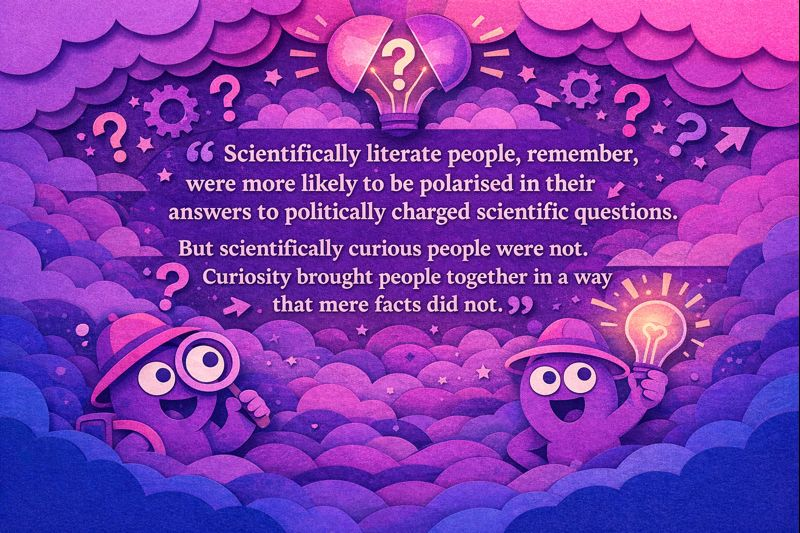
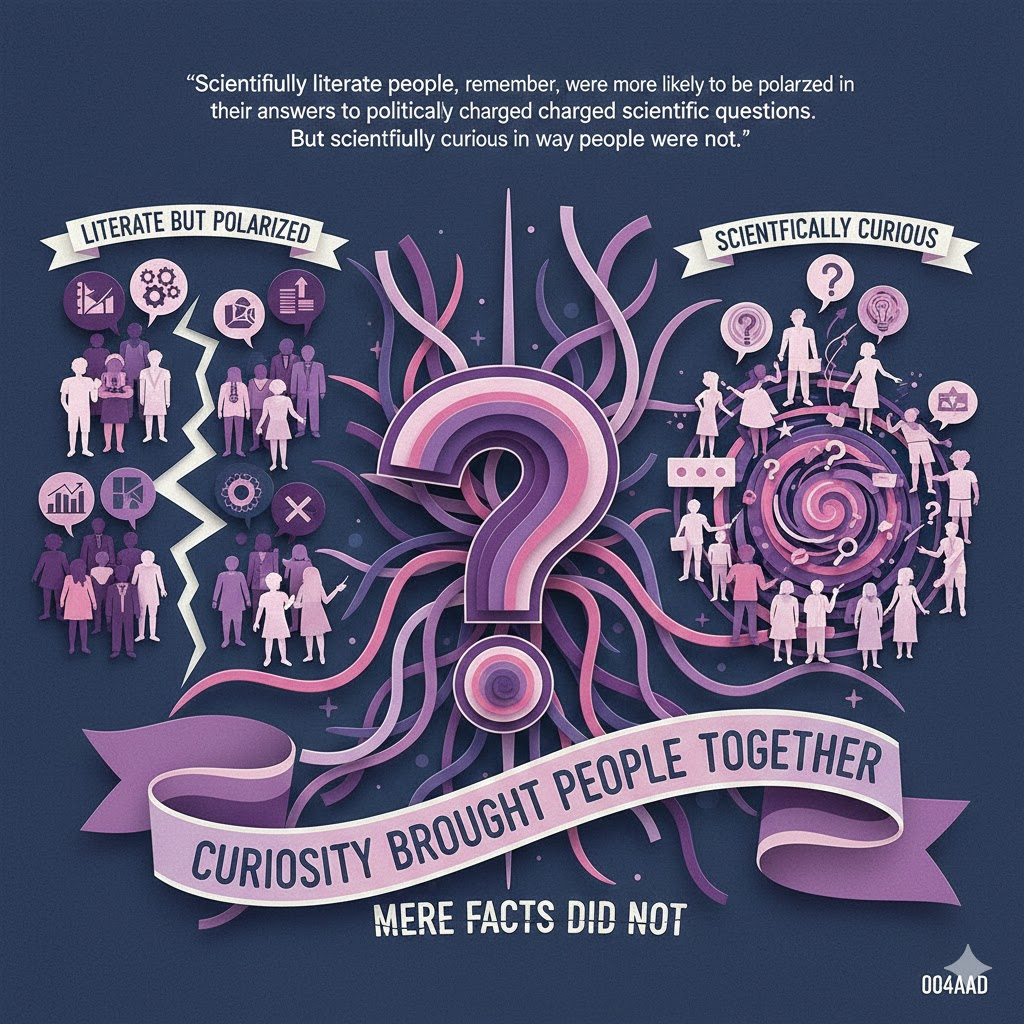
Scientifically literate people, remember, were more likely to be polarised in their answers to politically charged scientific questions. But scientifically curious people were not. Curiosity brought people together in a way that mere facts did not.
Question the cows
With the advent of the internet, and the proliferation of AI, broadcasting information is less relevant than about playfully introducing cognitive dissonance – effectively training people to follow the scientific method of inquiry, being questioning, without being judgemental about the evidence. As humans, we’re not very good at the not being judgemental bit, particularly when it comes to separate the evidence and the person presenting it.
Scientific method of inquiry + ethic of care = sense of belonging.
For the most part, being curious is hard: the “user interface” or “user design” for curiosity needs improvement. There are many heartwarming examples of people finding amazing information, making new friends and joining new communities through for example Wikipedia rabbitholes or exploring open world games like SecondLife, but this requires an existing desire, or bravery, to struggle through many dead-ends, boring “side-quests” or failed attempts to find what you need, facing potential embarrassment, and having to suffer through weird ways to navigate information. There is a lack of globally accessible user-friendly resources for people to find, explore, use, or play with information that could matter to them in a way that makes sense to non-specialists. In my work, I am interested in how we learn and interact with nature, and I believe the virtual world can help visualise our links with nature, and more importantly cultivate communities of interest – a sense of belonging – centred around important issues.
And so, after sharing what got me to my current work, it’s time to give some thought to how this can be achieved technically.
Part C: The Metaverse = Interoperability of data.
There is a lot out there in terms of using games, and virtual worlds for education already. Through for example Open Simulator, the virtual worlds themselves, and related community components already exist. I want to focus here on a different aspect of what we consider the Metaverse: the interoperability of data.
The advances of geospatial mapping and knowledge infrastructures more generally unlocks potential for using physical world assets in games. Using physical world assets in emergent approaches to game design is well suited to allowing players to interact with their game worlds in varied ways.
I mentioned that we can improve on this in one way by extending the ecosystem beyond a specific platform, making platforms and the data within them interoperable, so I want to share some thoughts on that now.
Integrating knowledge infrastructures
The complex information available about our interactions with nature is virtually invisible to anyone outside of those professionals directly working with the data. Examples of this complex information are our interactions with natural resources like water or energy, including key characteristics of these resources, the infrastructure that connects these resources to us, and the services nature provides. If this data is available, it is currently delivered to us as a take-it-or-leave-it, top-down option that we are expected to passively believe and accept: no chance for curiosity, for playing with this data. What’s worse, as outsiders it is hard to even find out how to get help finding the information in the first place! To adapt to a changing world and regenerate our world and our relationships, we need to work together from the bottom up. How can we build a better world together if we can’t even see what is going on?
Integrating big data, or integrating knowledge infrastructures, is an ongoing interest for a group of us. One component of it is the interaction, or lack thereof, by everyday people. Because of the bigness of this data and one could say the necessity of visualizing it, there is a digital, and likely an immersive component to it – the idea of the Metaverse that many people have. Imagine schools, libraries and local government – all potential custodians of the Commons – being integrated and accessible to their local citizens, facilitated by open digital frameworks. The other component is the technical integration of these knowledge infrastructures. Informally, we discuss this in the Open Metaverse Interoperability (OMI) group, and everyone is welcome to join – whatever the metaverse means to you. We are also more formally considering this integration from the urban water management angle in a European research project that has just started called “AquaSavvy”.
5. Call to action
If this interests you, get in touch! We are looking for community members to join the journey, in whatever form works for you – casual conversations, sharing knowledge and existing work, building components of the greater ecosystem. We are also looking for consortium members to pursue research funding, or strategic partnerships with companies interested in the commercial potential of these approaches.
Get in touch
The Open Metaverse Interoperability Group (OMI) website: omigroup.org/, most of our communication happen on Discord
Contact: indiebio@aquasavvy.eu, or @indiebio on the webs.
As a collective, we are using digital technologies to address the challenge of interacting with complex knowledge ecosystems. We use people-centric technology development to empower informed, accountable action from the bottom up. Using digital hyper-connected, integrated technologies – what we understand as the Metaverse – potentially gives grassroots initiatives the ability to contribute to the growing integrated knowledge ecosystem – the Metaverse ecosystem – and thereby scale their efforts and networks globally.
Further reading
About the author
Name presented as: Bernelle Verster (indiebio)
Bernelle Verster is a biologist by training, who took a side-quest into engineering and ended up in urban resource management. In the Metaverse she goes by indiebio: indie for independent, as in indie rock, and bio as in biology. Her interest in the Metaverse is the meta-part of it, rather than the visual or the virtual. It’s the interoperability of data, cultures, the physical with the digital, basically, how everything interrelates, and more importantly, the spaces between.
Bernelle is not an educator, but believes that the digital can do more to supplement curricula and pedagogy. It can also help lifelong learning beyond formal education, and build relationships between the youth and elders.

Images
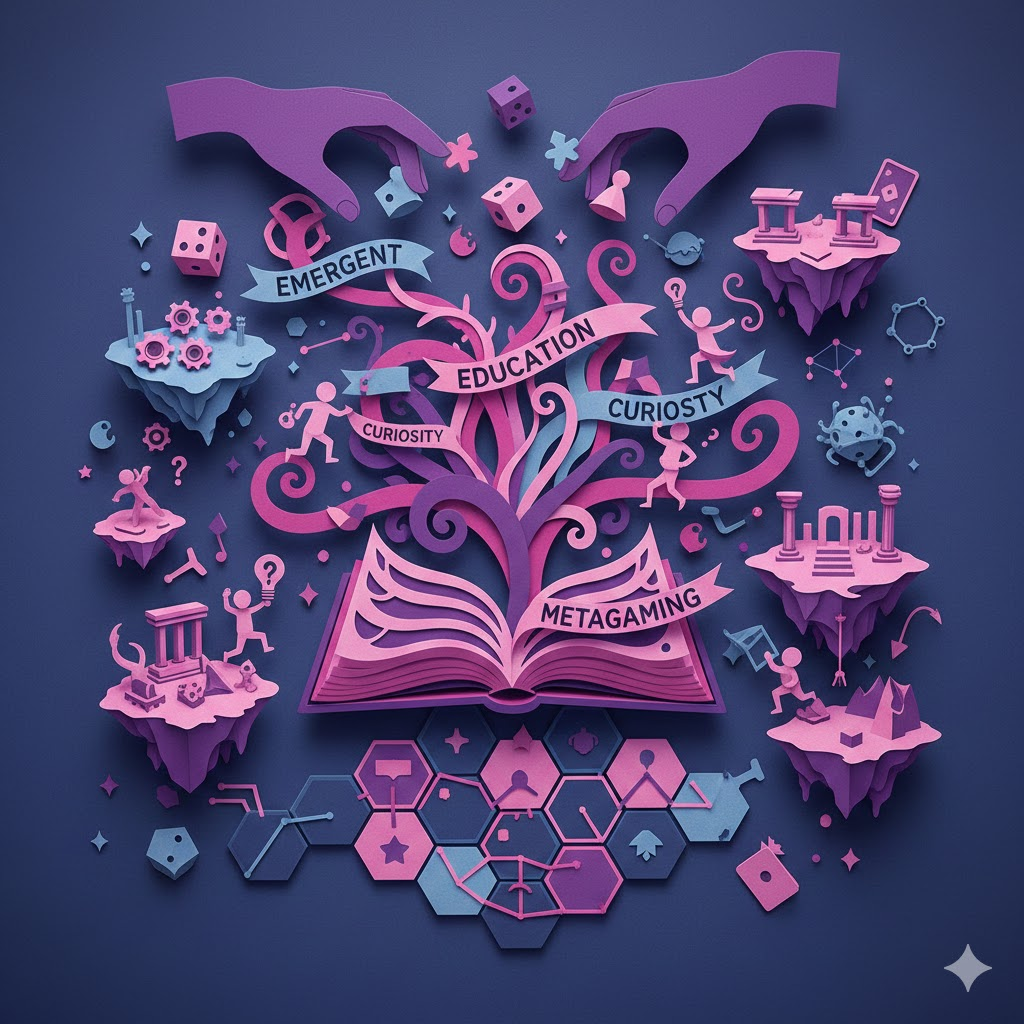
The images were created by Gemini, using the prompt “can you create an image about (for example emergent education / curiosity (insert topic here)) in a layered paper look, using only the colours #b337e2, #eb44d1, #d13ed9, #932fec, #004aad (the OMI colours).