

In the past week, friends have had intertwining conversations that I want to try weave together here. The overarching theme is the power of information to make care, visible. To make the connections and relationships between everything visible. If this in turn has the power to change anything, well, that is another thing and where the post unravels towards the end.
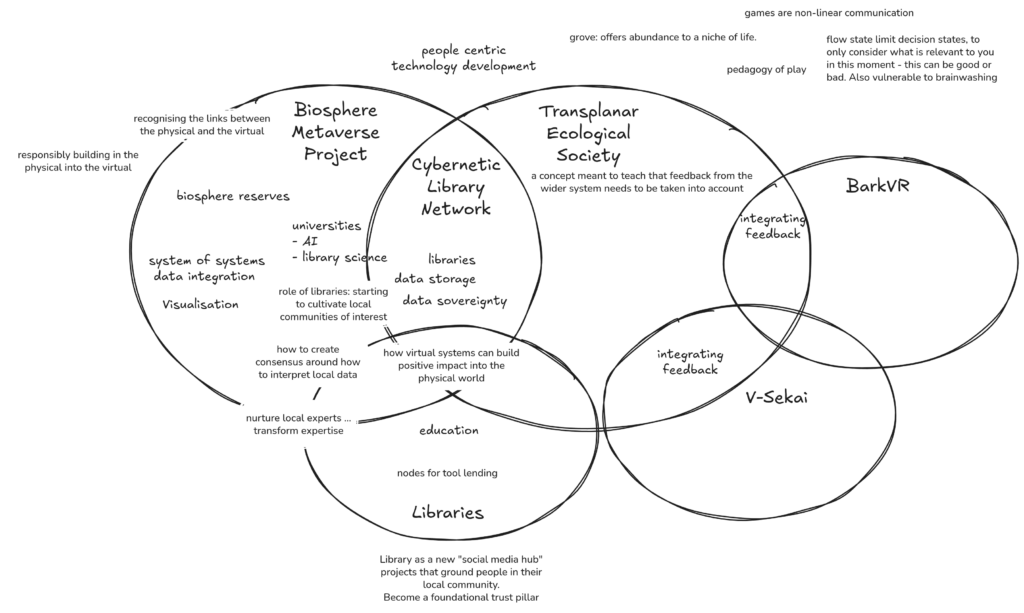
Astral asked what and why I am trying to do with my Biosphere Metaverse project. To me, at its core, it’s about reducing the information asymmetry around what is happening in our world.
This then reminded me about Carol Gilligan, where she says “silence is essential to maintaining a patriarchal order” And resisting patriarchy is about breaking that silence (In a Human Voice, page 33 – selected notes in another post ).
Care-giving and care-taking
Carol also said (paraphrased): Care work, for the most part underpaid and undervalued, has been burdened by the gendering of caring as “feminine,” … are considered lesser. In reality, this is the lion’s share of care work, including for people who claim to be independent and thus not to need care. Hence the people who care for them must be invisible, and do their work in silence.
… which then begs the question, What is the nature of a democratic conversation that excludes that which makes it materially possible?
To me this is true for care work, and it is true for our relationship, or dependence on, natural resources. Obscuring our exploitation – of women, of nature, of minorities – is central to maintaining the illusion of democracy, of development, or progress. I don’t know what to call addressing this as a collective, ecofeminism?
Ecofeminist(?) metaverse
maximus, another OMI member said about the spatial web: “the metaverse answers how technology and data come together to represent information” or more generally: “the metaverse provides a layer for sharing data across digital worlds”. So the metaverse, to me, is a tool to break the silence, to reveal the links and the care that is done.
Much of the current talk and hype around the metaverse turns around increasing surveillance, increasing extraction of data from people, increasing splintering towards libertarian independence – cleverly disguised as “decentralised” but really just wanting to maintain the invisibility of the care systems that make life possible.
For me, and I think most, if not all, of the members of OMI, it’s using similar technology approaches to do the opposite. … I edited same to similar because of the rippling effects of, e.g. blockchain and AI in terms of energy usage, and the fundamental requirement to be open. So similar and yet so very different. We are building to increase connection while reducing surveillance, reducing the possibilities for exploitation. To make data, assets, frameworks, worlds, more available for grassroots people to play with, interconnect, and build. To meet people where they are, rather than assume everyone is going to be wearing a fancy headset.
And then, HOW that is done, how this metaverse is built, links (perhaps in somewhat abstract ways) to conversations with a new friend about our personal relationships. It’s one thing to talk about “breaking the silence” and “making care work visible” and “smashing patriarchy” and all that, but when that “patriarchy” wears the face of the person you love, and who you care for silently and without getting care in return, the personal that was political gets very personal again. Then we are faced with strategic choices. We choose to remain silent again, sometimes. We start seeing the impossible trade-offs in context. That is where I am stuck with, and tired, and sad about right now. How to navigate all this.
… For example, with AI, it is a powerful set of tools, and the complexity of the data out there that needs integration to deal with our challenges make AI virtually indispensable. We can’t just say, we’re not going to use it. But we need to do so responsibly, and carefully. This increases the care-giving towards whatever we’re working with, ten-fold. Adding to the exhaustion. I unravel.
Carol Gilligan did her work about an ethic of care on women facing the choice of abortion. She acknowledged it was a moral dilemma, a situation where hurt is inescapable, where there is no “right” or “good” solution (page 33).
Complementing an ethic of justice, then – the rule of law – an ethic of care looks at the bigger picture, and “rather than seeking justification, the moral imperative becomes “an injunction to care, a responsibility to discern and alleviate the ‘real and recognizable trouble’ of this world.”
2 Replies to “Care-giving, care-taking, and the feminist metaverse”